Introduction
Topology optimization has greater impact on the downstream parts of a design process than size or shape optimization because topology should be determined before the size or shape. But, a major drawback of this method is the computational time, especially for the large-scale practical problems that often occur in the automobile industry and the aircraft industry. Parallel processing might help but that is not in the realm of topology optimization per se and does not resolve the inherent problem of inefficiency.
The concept of the design space optimization in this research introduces an evolutionary method in which it starts with a small design space and advances to a larger space with a large number of design pixels; the method eventually achieves an optimal design space. In addition, an adaptive mesh refinement strategy of the finite element method (FEM) is applied for efficiency. This method selectively refines elements according to a refinement priority from the viewpoint of optimization, which is aimed to efficiently improve the accuracy of a structure's global properties (compliance for example) with fewer elements as well as the clearness of the domain boundary.
1. Design Space Optimization [1]
In Design Space Optimization, the number of design variables is used as a design parameter to be optimized. When this new framework is applied to structural topology optimization, the design domain is not a fixed one but it evolves during the progress of optimization. In order to determine the effect of adding or deleting new design variables in topology optimization, we have to conduct sensitivity analyses. In this case, however, mathematical sensitivity analysis is not mathematically feasible because the functional change in term of number of design variables is mathematically discontinuous. Kim and Kwak [1] proposed an intermediate phase - pivot phase - which enables sensitivity analysis for this discontinuous process. The following figure explains the concept of pivot phase:
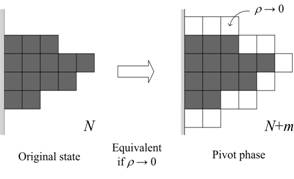
To calculate the design space sensitivity (DSS) analysis, we put a layer of new elements with a very low density near zero. The total number of elements changed from N to N+m (where m is the total number of newly created elements), but this addition made no change to the structural status, such as compliance or weight. The resulting space was the pivot phase. With this pivot phase, we could then obtain the DSS or the directional derivative by taking a derivative with respect to density ri and then taking the limits as:

In the case of compliance minimization, we can derive the DSS as:

where C is compliance of the structure, U the local nodal displacement vector, and ki denotes the local stiffness matrix.
This method was applied to structural topology optimization for design domain change, plate problems for design domain refinement, and MEMS (Micro Electro Mechanical Systems) applications.
2. Extension of Design Space Optimization [2]
The original design space optimization is extended to include domain refinement in topology optimization as well with advanced techniques in domain change.
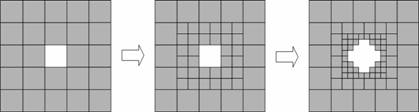
The most time-consuming part of a design space optimization is searching for an optimal design space. If we start a topology optimization with the finest mesh resolution, the subsequent large number of design variables and layouts in the design space requires too much calculation time. A better way to search for an optimal design space is to start with a coarse mesh and to adopt a sequence of design space refinements. Before starting such a procedure, we set the number of refinements which will be done during the procedure. At the beginning, we can find a rather rough optimal design space by using a low refinement level. A converged design space actually denotes the design space of the optimum topology. This means there is no need to expand or reduce the design domain, that is, an expansion would not bring in any new structural material. When we find an optimal design space at the refinement level, we can refine the FE model and thereby improve the design space for the next optimization process. This process continues until we get the desired optimal design space at the target refinement level.
3. Case Studies [2]
1. Knuckle in the suspension system of an automobile
A knuckle is a component of the suspension system of a vehicle and linked with a damper, LCA (lower control arm), and tie rod to transfer load and control steering. Figure below shows the boundary condition and FE model of a knuckle. This knuckle was loaded with 3 different load cases as the extreme during driving; lateral kerb strike, pot hole brake, and ultimate vertical mode. For optimization, compliance was chosen as an objective function and a weighting sum was used to treat the multiple load cases.
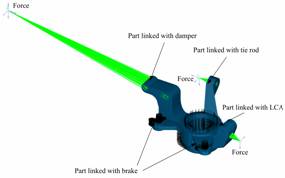
After 5 times design space adjustments and 1 time design space refinement, we got an optimized knuckle as follows.
2. Bone fracture healing
The importance of computational simulations in biomechanics has grown recently due to the difficulty of obtaining experimental or clinical results. With assumption that bone is the self-optimizing structure under the given loading condition, a step of design space adjustment on compliance minimization is well matched with a time step in fracture healing. As an initiative study, we modeled the long bone with a defect as a hollow cylinder with a cutout for simplification. Bone material was assumed to be homogeneous and isotropic. The detailed model is shown in the figure below.
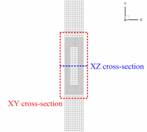
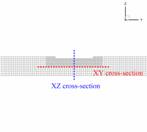
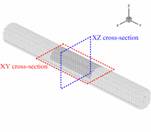
Under each of compression and torsion, bone was healed as followings.
3. Bridge design
According to the structural shape, bridge design is divided into girder, truss, arch or suspension bridge. When we construct a certain bridge, we need to first choose the appropriate type of bridge under given boundary condition, construction cost, etc. In conventional cases, the designers select the type with their experience and intuition. We can get some help from topology optimization about such a conceptual design. The figure below is given boundary condition for the bridge.
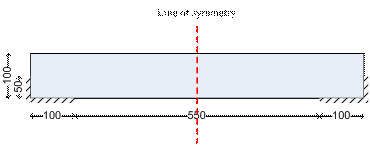
Under this condition, we got the optimized bridge and compared the result with Lu Pu steel arch bridge in Shanghai, China.
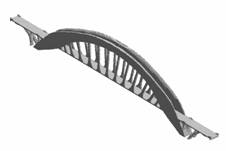

Optimized Bridge
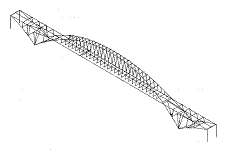
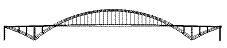
Lu Pu Steel Arch Bridge
Publications
[1] I. Y. Kim and B. M. Kwak (2002) Design Space Optimization Using a Numerical Design Continuation Method. International Journal for Numerical Methods in Engineering 53, 1979-2002
[2] I. G. Jang and B. M. Kwak (2006) Evolutionary Topology Optimization Using Design Space Adjustment Based on Fixed Grid. International Journal for Numerical Methods in Engineering 66, 1817-1840